How Do I Cut My Token Bill with Caching?
The Taco Tuesday assistant sends the full menu and operating instructions with every order. Those repeated input tokens can become a significant part of the request cost even when the content has not changed.
Prompt caching lets supported providers reuse that stable prefix instead of charging the full input rate each time.
Outcome
Enable automatic caching on the ordering assistant's model and prove, with token counts from two consecutive requests, that the second one read the menu from cache instead of paying full price.
Fast Track
- Add
providerOptions: { gateway: { caching: 'auto' } }to a call with a big stable prefix - Run the same request twice
- Compare
usage.inputTokenDetails.cacheReadTokens: near zero the first time, nearly the whole menu the second
Hands-on exercise
Build scripts/cache-check.ts with two identical requests and print the token details for each one.
Requirements:
- Use an Anthropic model (
anthropic/claude-sonnet-4.6), because Anthropic needs the explicit markers, which makes the Gateway's work visible - Send the full
TRUCK_INSTRUCTIONS(menu included) asinstructions, plus a short customer question - Set
caching: 'auto'underproviderOptions.gateway - After each call, print
inputTokens,cacheReadTokensfromusage.inputTokenDetails, and the actual cost fromgateway.cost
Caching requires at least two requests to demonstrate a hit. The first request writes the cache entry and may carry a write premium; the second request can read it at the cached-input rate.
Try It
pnpm cache-check--- Request 1 ---
Input tokens: 612
Cache read tokens: 0
Cost: $0.002214
--- Request 2 ---
Input tokens: 612
Cache read tokens: 578
Cost: $0.000371
The second request reports most of the stable prefix as cache-read tokens and shows the lower request cost.
Two issues you may encounter:
cacheReadTokens is 0 on the second request. Check the provider's current cache lifetime and confirm that the stable prefix is byte-identical. A timestamp or request-specific value in the instructions prevents a prefix match.
The second request used another provider. Cache entries live with a provider, so changing providers can produce a miss. Pin cache-sensitive traffic when consistency matters, as shown in lesson 1.7.
Commit
git commit -m "feat(caching): enable automatic prompt caching for the menu prefix"Done-When
scripts/cache-check.tsruns two requests and prints both receipts- Request 2 shows
cacheReadTokenscovering most of the menu - Request 2's actual cost is visibly smaller than request 1's
- You can say when
caching: 'auto'would lose money (one-shot traffic)
Solution
import { generateText } from "ai";
import { TRUCK_INSTRUCTIONS } from "../lib/menu";

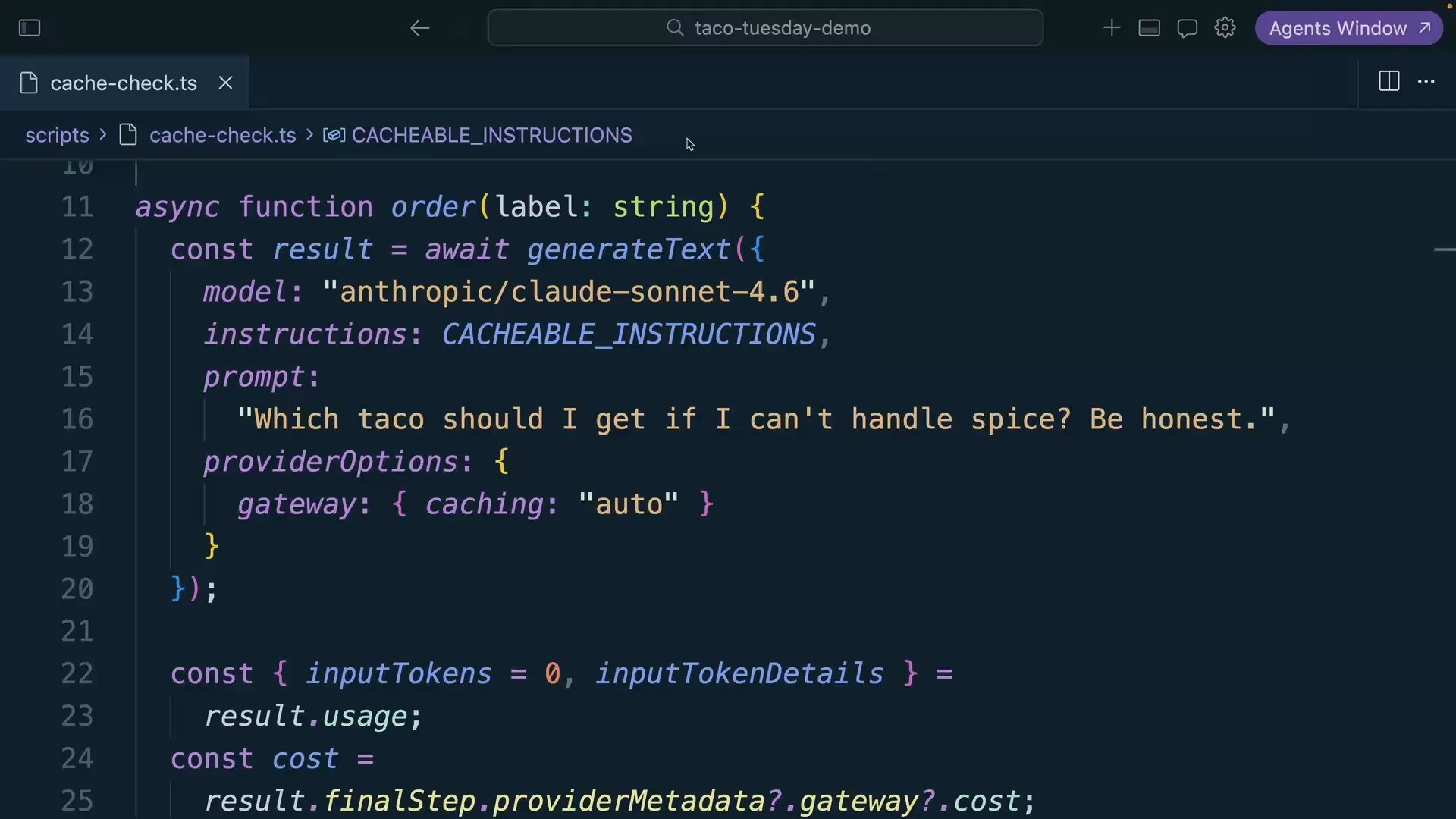
async function order(label: string) {
  const result = await generateText({
    model: "anthropic/claude-sonnet-4.6",
    instructions: TRUCK_INSTRUCTIONS,
    prompt: "Which taco should I get if I can't handle spice? Be honest.",
    providerOptions: {
      gateway: { caching: "auto" },
    },
  });

  const { inputTokens = 0, inputTokenDetails } = result.usage;
  const cost = result.finalStep.providerMetadata?.gateway?.cost;

  console.log(`--- ${label} ---`);
  console.log(`Input tokens:      ${inputTokens}`);
  console.log(`Cache read tokens: ${inputTokenDetails?.cacheReadTokens ?? 0}`);
  console.log(`Cost:              $${cost}`);
}

await order("Request 1");
await order("Request 2");
The second request's token metadata tells us whether the provider reused the prefix and how that changed the cost.
Related Questions
Was this helpful?