How Do I Survive a Provider Outage?
Taco Tuesday cannot wait for us to write fallback code during lunch. We need to choose the provider and model sequence while every service is healthy.
We will configure provider failover and model fallback while every service is healthy.
These controls cover two failure levels. Provider failover keeps the same model and tries another host. Model fallback moves to a different model after the preferred model has no available provider.
Outcome
Configure both failover layers on the order flow, and know how to read a failover event off a response.
Fast Track
- Add
orderandmodelsunderproviderOptions.gatewayin a call - Run
pnpm outage-drill - Compare the healthy attempt log with the captured failure trace
Hands-on exercise
Because you cannot schedule a provider outage for practice, this exercise configures both fallback layers and teaches you to read attempt metadata before an incident occurs.
Requirements:
- A
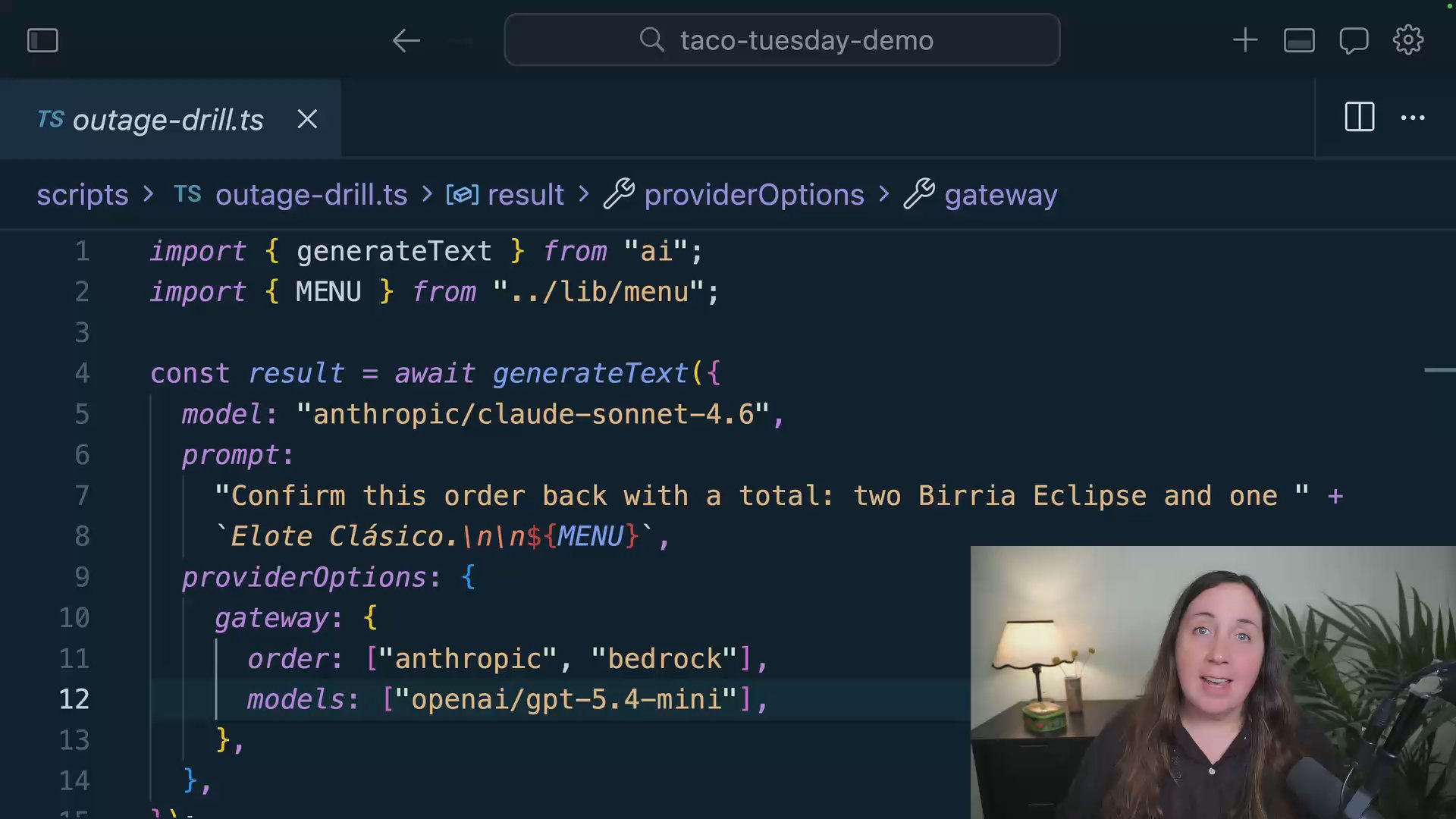
scripts/outage-drill.tsthat calls the order-confirmation prompt onanthropic/claude-sonnet-4.6 order: ["anthropic", "bedrock"]: prefer direct, name the first fallbackmodels: ["openai/gpt-5.4-mini"]: use the previous order model if Claude is unavailable across its providers- Walk
modelAttemptsand print every attempt: model, provider, success or the error
The wrong way, for contrast, is the try/catch pyramid: catch the Anthropic error, retry Bedrock by hand, catch that, swap models, each with its own SDK and error shape. That approach creates additional integration and maintenance work.
Try It
pnpm outage-drillOn a healthy run, the first provider may succeed:
anthropic/claude-sonnet-4.6 via anthropic — ok
Survived. 1 model tried, 1 provider attempt.
The example below is a previously captured and sanitized failure trace:
anthropic/claude-sonnet-4.6 via anthropic — failed: Internal error
anthropic/claude-sonnet-4.6 via bedrock — ok
Survived. 1 model tried, 2 provider attempts.
The captured trace shows a failed attempt followed by a successful retry. Do not stage a fake provider failure and present it as live output.
Two issues you may encounter:
Your model has one provider. Then order has nothing to reorder and provider failover can't save you; the models array is your entire outage plan. Check the model's page for its provider count; it changes how much you should trust layer one.
The fallback model answers in a different style. Evaluate every backup against the feature's quality, latency, tool, and output requirements. Some features should return a controlled error instead of accepting a poor fallback.
Commit
git commit -m "feat(failover): add provider order and model fallback to the order flow"Done-When
- Both layers configured:
orderfor providers,modelsfor the deep failure - The drill script prints the attempt log on a normal day
- You can explain provider failover vs model fallback in one sentence each
- You know how many providers serve your primary model
Solution
import { generateText } from "ai";
import { MENU } from "../lib/menu";

const result = await generateText({
  model: "anthropic/claude-sonnet-4.6",
  prompt:
    "Confirm this order back with a total: two Birria Eclipse and one " +
    `Elote Clásico.\n\n${MENU}`,
  providerOptions: {
    gateway: {
      order: ["anthropic", "bedrock"],
      models: ["openai/gpt-5.4-mini"],
    },
  },
});

const routing = result.finalStep.providerMetadata?.gateway?.routing as any;
const modelAttempts = routing?.modelAttempts ?? [];
let attempts = 0;

for (const m of modelAttempts) {
  for (const p of m.providerAttempts ?? []) {
    attempts++;
    const outcome = p.success ? "ok" : `failed: ${p.error}`;
    console.log(`${m.canonicalSlug} via ${p.provider} — ${outcome}`);
  }
}

console.log(
  `Survived. ${modelAttempts.length} model${modelAttempts.length === 1 ? "" : "s"} tried, ` +
  `${attempts} provider attempt${attempts === 1 ? "" : "s"}.`
);
With both fallback layers configured, the order flow can continue through a provider or model failure.
Related Questions
Was this helpful?